
For Colorado homeowners, the timeless beauty of hardwood flooring is highly sought after. However, the choice isn’t just about color and species; it’s about construction, specifically, whether to choose solid or engineered planks. In a place like Denver, where homes battle the extremes of dry, high-altitude air and intense seasonal temperature shifts, the structural integrity of your floor is paramount.
The difference between solid and engineered hardwood is magnified in the Colorado climate, directly impacting the floor’s stability, appearance, and longevity.
Understanding the Construction Difference
The difference between these two floor types comes down to how they handle moisture, the number one enemy of wood.
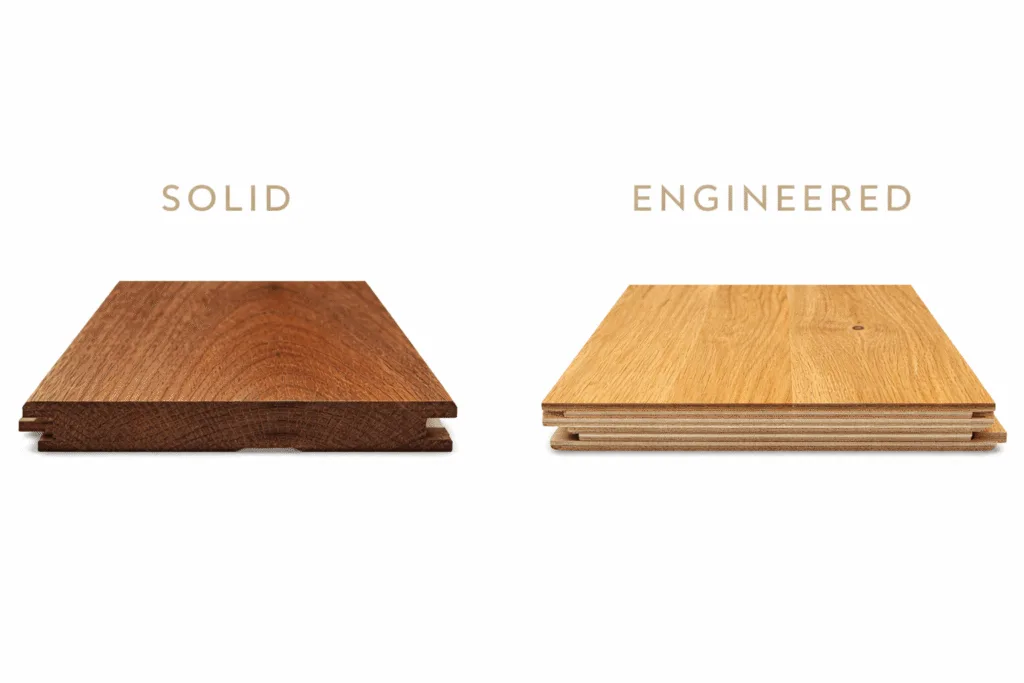
- Solid Hardwood: Each plank is a single, continuous piece of timber (usually 3/4″ thick). It expands and contracts as a whole unit in response to humidity changes.
- Engineered Hardwood: A thin veneer of real wood (the wear layer) is fused to multiple layers of plywood or HDF (High-Density Fiberboard), which are cross-stacked and glued under high pressure. This cross-grain construction counteracts the natural swelling and shrinking forces of the wood.
The Climate Factor: Stability in Denver
Denver’s dry, continental climate and high elevation present a unique challenge to hardwood flooring.
| Climatic Challenge | Impact on Wood Flooring | Preferred Solution |
| Extreme Dryness (Winter) | Causes the wood to lose moisture and aggressively contract, leading to wide gaps between planks and cracking/checking. | Engineered. Cross-ply core limits contraction. |
| High Seasonal Fluctuation | Leads to continuous movement (expansion and contraction), severely straining the structural integrity of the planks. | Engineered. Superior dimensional stability. |
| Basement Installation | High risk of moisture intrusion and higher humidity levels than upstairs. | Engineered. Its composite core is rated for below-grade installation. |
In the Front Range region, Engineered Hardwood is generally considered the safer, more stable, and more structurally sound option by flooring crews, specifically because it manages the area’s sharp humidity swings much better than solid wood.
The Case for Engineered Hardwood (The Practical Choice)
For the majority of Denver homes, engineered hardwood is the practical winner due to its ability to handle environmental stress.
- Superior Dimensional Stability: Engineered planks are far less likely to cup, crown, or crack when humidity levels fluctuate, making them ideal for the challenging Colorado environment.
- Installation Versatility: Engineered planks can be installed on any level of the home, including over concrete slabs (common in split-levels and ranch homes) and in basements, where solid wood should never be installed.
- Compatibility: It is the only safe hardwood option for use over radiant heating systems, which are popular for supplemental heating in cold climates.
The Case for Solid Hardwood (The Lifespan Champion)
Solid hardwood’s primary advantage is its immense long-term value, but this value is conditional on strict maintenance.
- Maximum Refinishing: Solid wood can be refinished many times (up to 7 times over a century), whereas engineered wood is limited by the thickness of its top veneer (typically 1–3 times). If you want a floor that truly lasts 100 years, solid hardwood is it.
- Aesthetic Purity: Some homeowners prefer the look and feel of a single, continuous piece of wood, especially for historical or high-end traditional properties.
- The Caveat: Homeowners with solid hardwood in Denver must invest in and consistently run a whole-house humidification system, especially during the dry winter months, to prevent destructive shrinkage and gapping.
Summary of the Hardwood War in Colorado
| Feature | Solid Hardwood | Engineered Hardwood |
| Moisture/Humidity Stability | Low (Prone to gapping/checking) | High (Excellent dimensional stability) |
| Installation Location | Must be installed above-grade over plywood only. | Can be installed on any level, including concrete/basements. |
| Refinishing Lifespan | Very High (Multiple times over 50+ years) | Limited (1–3 times, depending on veneer) |
| Initial Cost | Often higher material cost. | Often lower to mid-range material cost. |
In short, while solid hardwood offers maximum refinish potential, Engineered Hardwood offers the necessary stability for the dry, shifting climate of the Denver area, making it the recommended construction for almost all modern home applications.
Shop premium wood floors from reliable flooring partners in Denver.


