

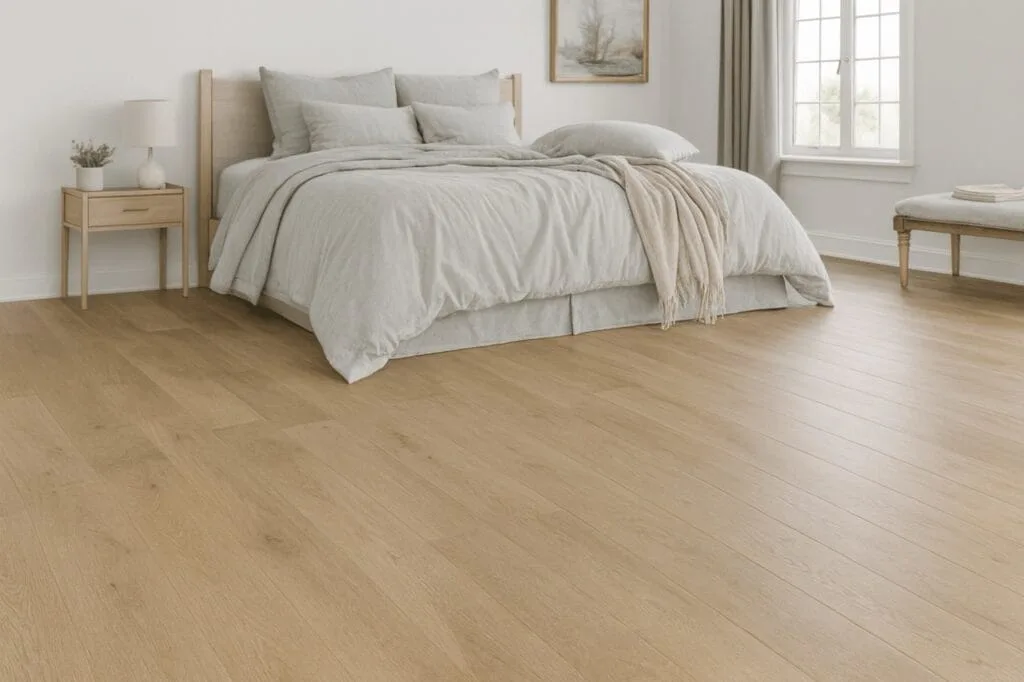
Hardwood flooring is a cornerstone of classic home design, offering natural beauty and unparalleled longevity. However, unlike simpler flooring types, choosing hardwood requires navigating several key technical and aesthetic decisions that will influence its performance, final appearance, and cost. It’s not just about picking a stain color—it’s about choosing the right material composition for your home’s environment.
Here are the five essential factors you must consider to select the perfect hardwood floor.
1. Construction: Solid vs. Engineered Hardwood
The first, and most important, technical choice is the type of construction, which dictates where the floor can be installed.
Solid Hardwood
- Composition: Planks milled from a single piece of timber.
- Pros: Can be sanded and refinished multiple times (up to 5-7 times), offering the longest lifespan (100+ years). Adds highest resale value.
- Cons: Highly sensitive to moisture and humidity changes. Can only be installed above grade (on or above ground level).
Engineered Hardwood
- Composition: A veneer of real wood (the wear layer) glued to a stable core of plywood or HDF (High-Density Fiberboard).
- Pros: Much greater dimensional stability, meaning it handles moisture and temperature swings better than solid wood. Can be installed below grade (in basements) and over concrete slabs.
- Cons: Can only be refinished a limited number of times (1-3 times, depending on the veneer thickness).
2. Species and Hardness (The Janka Rating)
The wood species you choose directly affects the floor’s durability and ability to resist dents and scratches. This hardness is scientifically measured using the Janka Hardness Scale.
- High Janka Rating (Hard Woods): Species like Hickory, Maple, and White Oak offer superior resistance to impact and heavy foot traffic. They are the ideal choice for busy households, active family rooms, and owners with large pets.
- Mid-Range Janka Rating (Standard Woods): Red Oak is the industry standard—durable, affordable, and accepting of many stains.
- Low Janka Rating (Soft Woods): Woods like Pine and Cherry dent and scratch easily. While beautiful, they require very low-traffic environments and diligent maintenance.
3. Finish Type: Prefinished vs. Site-Finished
The protective coating applied to the wood defines its immediate durability and final aesthetic.
- Prefinished: The finish (typically multiple coats of polyurethane with Aluminum Oxide) is applied and cured in a factory before installation.
- Pros: Extremely durable finish (often backed by long warranties); faster installation time; less mess (no sanding/staining dust).
- Cons: Creates micro-bevels (small grooves) between planks, which can collect dust.
- Site-Finished: Unfinished wood is installed, then sanded, stained, and sealed on-site.
- Pros: Creates a seamless, completely flat, monolithic look; allows for custom stain matching throughout the home.
- Cons: Installation is long (several days to a week for curing); creates significant dust; finish is typically less durable than factory-applied Aluminum Oxide.
4. Plank Dimensions: Width and Length
The width of your planks is an aesthetic choice that dramatically alters the perceived size and style of a room.
- Narrow Planks (2.25″ to 3″): Traditional and common in older homes. They make a small room appear slightly larger due to the increased number of linear lines.
- Wide Planks (5″ to 8″+): Modern and trending. They lend a rustic, farmhouse, or high-end custom look. Wide planks work best in large, open spaces, as they minimize the number of seams.
- Length: Longer planks generally result in fewer end-to-end seams, offering a cleaner, more continuous, and higher-end look.
5. Cut and Grade (Visual Appearance)
The way the tree is milled (the cut) and the visual quality of the boards (the grade) impact the final look and price.
- Grade (Knot Content):
- Clear/Select Grade: Contains few to no knots or natural imperfections; provides a clean, uniform look but is the most expensive.
- Character/Rustic Grade: Features prominent knots, mineral streaks, and varied grain patterns for a distressed or natural aesthetic.
- Cut:
- Plainsawn: The most common and affordable cut, displaying curved or cathedral grain patterns.
- Quartersawn/Riftsawn: Cut to maximize stability and minimize expansion/contraction. Features straight, tight grain patterns but is significantly more expensive.
By carefully considering each of these factors—from the core construction to the surface aesthetic—you ensure that the final hardwood floor you choose is not only beautiful but structurally appropriate for your lifestyle and home.


